5 Rental Industries Already Running Without On-Site Staff
April 15, 2026 · by igloo
5 Rental Industries Already Running Without On-Site Staff
When operators start researching rental automation, they usually have one question before everything else: who is already doing this?
Not in theory. Not in a case study from a different industry. In their vertical. With their type of equipment. With their type of customer.
It is a fair question. The evidence matters more than the argument. And across five rental verticals, the evidence is already there.
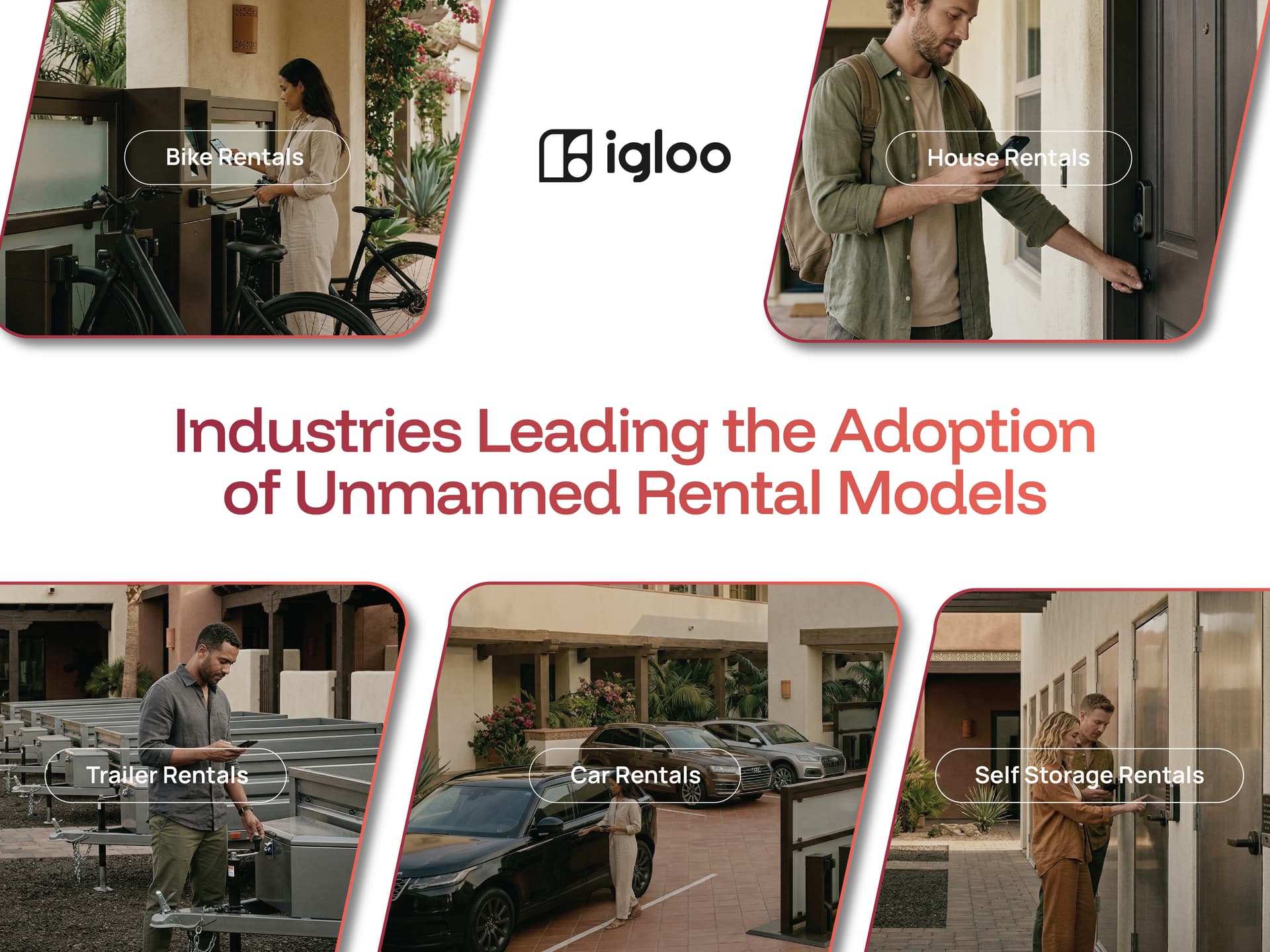
SUP and watersports. Bikes and e-bikes. Trailers. Camera and production gear. Self-storage. Each of these industries has found its own version of an unmanned, self-serve rental model. The specific mechanics differ. The enabling technology is the same.
Here is what each vertical looks like now, and what they all have in common.
1. SUP and Watersports Rentals
Outdoor watersports gear is a strong candidate for unmanned operations for one structural reason: peak demand and staff availability rarely align.
Paddleboards, kayaks, and watersports equipment are most in demand early in the morning, on weekends, and on public holidays. These are also the windows when staffing is most expensive, most difficult to schedule, and most likely to result in missed rentals when someone calls in sick or simply does not show up.
Paddle sports operators have addressed this directly. PADL launched what was described as the world's first automated paddle sports rental system, using a dock-based self-serve model where customers access equipment without any staff interaction, as reported by Supconnect. Kayak rental kiosks from operators like Outdoor Vending Solutions take a similar approach: customers select their watercraft via touchscreen, complete a waiver, pay, and unlock their equipment independently.
The operational logic is straightforward. When the handover is fully self-served, a single operator can manage a waterfront location without being physically present at every pickup and return. Morning slots, last-minute evening bookings, and public holiday peaks all become available without additional staffing cost.
For the digital access layer to work in this environment, the technology needs to function reliably outdoors, in humid and coastal conditions, and without a consistent internet connection. Time-bound access codes that work offline close that gap.
2. Bike and E-Bike Rentals
The bike rental vertical has been moving toward automated access for years, driven in large part by the growth of bike-sharing programs in urban environments. But the shift is not limited to city-scale operations.
The global smart bike lock market was valued at approximately USD 450 million in 2024 and is projected to reach USD 1.15 billion by 2032, growing at a CAGR of 12.5%, according to Future Market Report. Rental bike services and bike-sharing platforms represent a significant portion of that growth.
For independent bike rental operators, the unmanned model works at the station level. Bikes are secured with smart locks. Customers book through a mobile app or online platform, receive access credentials, and unlock their bike without any staff involvement. Returns are handled the same way. Automated systems flag overdue rentals, track utilization, and process payments in the background.
E-bike rental operators have adopted this model particularly quickly, driven by customer expectations around convenience and the need to operate profitably across multiple locations. Running a staffed counter at every e-bike pickup point is not economically viable at scale. Running a smart lock with a connected booking platform is.
The electric bike rental market is projected to reach USD 10 billion by 2033, growing at a 12% CAGR, with automation cited as a key enabler of multi-location operations, per Strategic Revenue Insights.
3. Trailer Rentals
Trailer rental might not be the first vertical that comes to mind when you think about automation. The equipment is large, the transactions involve vehicle connections and liability, and the customer base is often less tech-forward than, say, an outdoor gear renter.
Despite that, it is one of the most advanced verticals when it comes to unmanned operations. The reason is practical: trailer rental customers typically need access outside of business hours, and the cost of staffing for that access has always been high relative to the transaction value.
Sharefox documents a direct example: trailer rental operators using igloo padlocks to give customers unique access codes for pickup and return without any staff presence. The rental agreement, identity verification, and access code delivery all happen digitally before the customer arrives at the trailer. As Sharefox describes in their self-service trailer rental breakdown, the remote management capability also allows operators to track access and handle issues without being on-site.
Platforms like Lockii, which explicitly positions itself around igloo-powered trailer rentals, and Reservety both enable the complete flow: customer books online, identity is verified, access code is texted at payment confirmation, and the trailer is collected and returned without a single phone call or physical key exchange.
The audit trail that comes with digital access is also a significant operational benefit. Every access event is logged with a timestamp, creating a record that traditional key handovers cannot provide.
4. Camera Gear and Production Equipment Rentals
Camera and production gear rental has a customer profile that makes unmanned operations almost necessary rather than optional. Photographers, videographers, and production crews often need equipment for shoots that start before 7am or wrap after midnight. They work on weekends and on short notice. They cannot plan their gear needs around a rental shop's office hours.
The Toolbox24 operation in Vienna is the clearest working example in this vertical. Running as a fully unmanned 24/7 tool and equipment rental service, Toolbox24 uses igloo smart lockers as the physical access point. Customers book through Sharefox, receive time-bound PIN codes via Inlet, and collect or return equipment at any hour without any staff involvement. The full case study is available at igloo's blog.
The locker model is particularly well-suited to camera gear for a secondary reason: security. High-value equipment stored in a smart locker with time-bound access and a logged access history is more auditable than a key-in-a-lockbox or a handover that depends on staff being present and attentive.
Variocube's RentalCube system takes a similar approach, enabling 24/7 automated equipment collection and return via smart lockers integrated with existing booking platforms. The rental locker model is now being used across production houses, university campuses, and corporate environments for equipment that ranges from cameras to IT hardware.
For rental operators in this vertical, the unmanned model is not a cost-cutting measure. It is a competitive requirement. Operators who can guarantee 24/7 self-serve access are simply more useful to professional crews than those who cannot.
5. Self-Storage
Self-storage has the longest track record of unmanned operations of any rental vertical. The model is mature, the technology is well-established, and the case for it is no longer debated within the industry.
According to Inside Self Storage, the challenges that once made unmanned facilities difficult to operate have largely been resolved by technology. Customers can now rent units, make payments, manage their accounts, and access their storage entirely without any on-site staff involvement. Electronic access control and keyless entry systems handle what previously required a full-time manager.
Storable's breakdown of unmanned self-storage operations notes that the three core technology requirements are online booking and payment, a customer-facing website with a tenant portal, and a software-integrated access control system that can deliver access codes by SMS or email and remotely revoke access for non-payment.
The self-storage model also demonstrates what is possible when the unmanned approach is sustained over time. Operators who have run fully automated facilities for several years report that a small team can manage multiple locations remotely, with on-site visits limited to maintenance and unit inspections. The staffing math is fundamentally different from a traditionally managed facility.
Importantly, self-storage has also demonstrated that unmanned does not mean inaccessible. Customers consistently report high satisfaction with facilities that offer 24/7 keyless access, with the elimination of office hours being a feature rather than a limitation.
What All Five Verticals Have in Common
Across SUP rentals, bikes, trailers, camera gear, and self-storage, the operators who have successfully shifted to unmanned models share a consistent pattern in how they built their operations.
The booking is fully digital and triggers the access
In every case, the customer completes the transaction online before they arrive at the equipment. Payment, identity verification, and rental agreement are all handled digitally. The access credential is generated and delivered automatically when the booking is confirmed. There is no manual step between payment and access.
The physical handover is keyless
Keys are the single biggest bottleneck in traditional rental operations. They need to be prepared, handed over, returned, and tracked. Every one of those steps requires human involvement and creates a point of failure. Unmanned operations eliminate keys entirely, replacing them with time-bound digital codes or app-based access that activates and expires automatically.
Access works without a stable internet connection
Outdoor locations, marina-adjacent facilities, storage sites, and off-street pickup points all share one characteristic: connectivity is not guaranteed. The access technology used by operators in all five verticals needs to work when the WiFi does not. Offline-capable lock technology, where access codes are valid without a live connection, is the requirement that makes real-world deployment reliable.
Remote visibility replaces on-site presence
Unmanned does not mean unmanaged. In every vertical, operators maintain visibility over their operations through access logs, booking data, GPS tracking (in the case of trailers), and remote monitoring. The shift is from physical presence to digital oversight, and the data available to a remotely managed operation is often more detailed than what a staff member on-site would record manually.
The Common Starting Point
Every operator in these five verticals started from the same place: a rental business that depended on staff being physically present for every customer interaction. Every one of them reached the same conclusion: that dependency was costing them money, capping their capacity, and limiting their hours.
The access layer is what changed the equation. When the physical handover becomes keyless and the credential delivery becomes automatic, the entire operation changes shape. The bottleneck is gone. The hours extend. The staffing equation shifts.
These five industries figured that out at different times and through different paths. The infrastructure that enabled it in each case is the same.