Smart Access Control CapEx and ROI for Multifamily | igloo
April 14, 2026 · by igloo

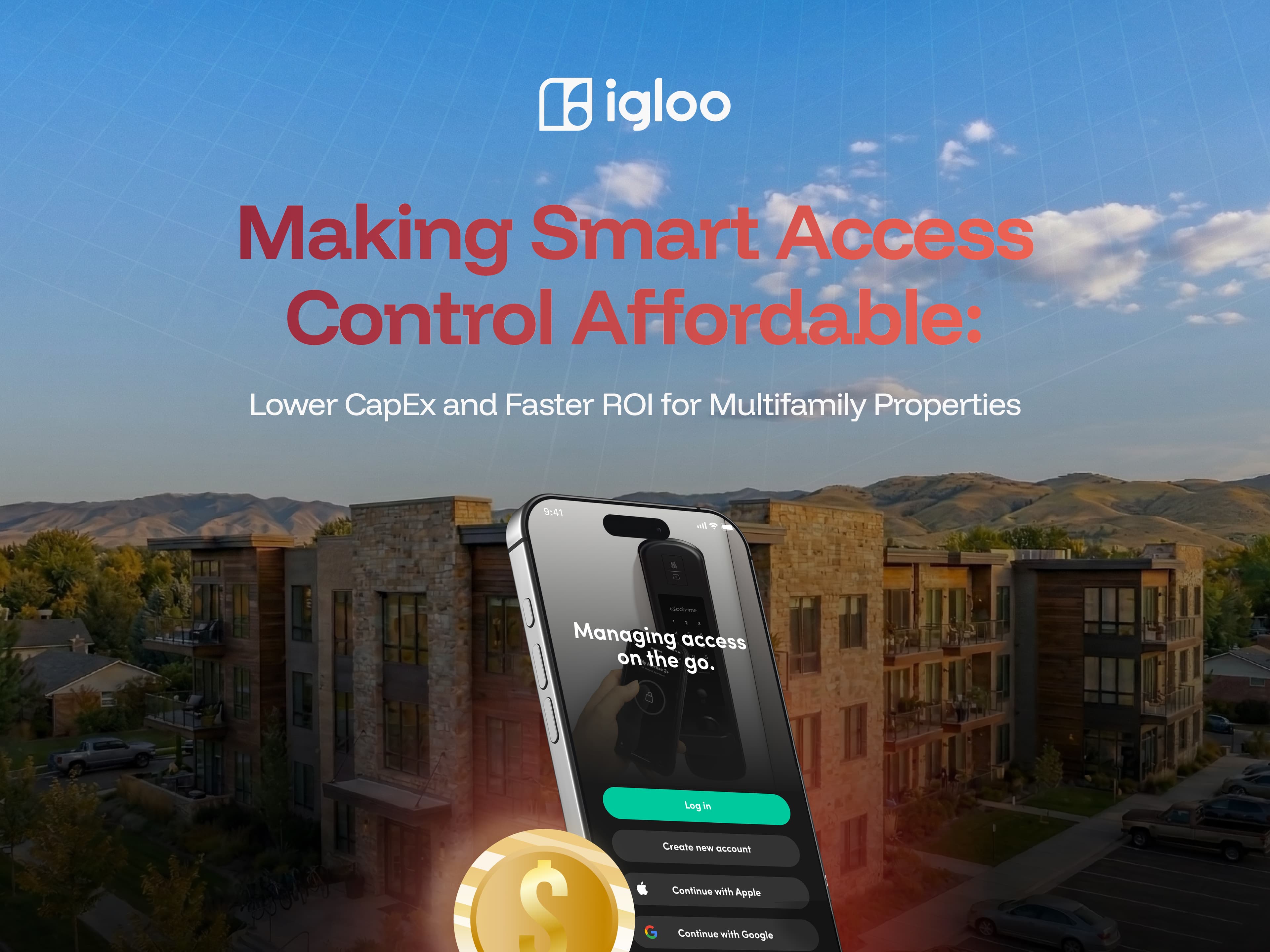
Making Smart Access Control Affordable: Lower CapEx and Faster ROI for Multifamily Properties
Here's what happens to most Class B/C property managers the first time they look into smart access control: they request a quote, they see the total, and they close the browser.
The number isn't wrong exactly. It's just built for a different kind of property: a new construction or recently gut-renovated Class A building where the walls are open, the infrastructure is fresh, and the budget has room for a capital technology project.
For everyone else, that quote does a lot of damage. It sets a mental ceiling on what smart access control costs, and it sends operators back to physical keys for another year, or two, or five.
This article is about the number behind the number: what smart access control actually costs when you separate the hardware from the infrastructure work that wired systems drag along with them, and what the payback math looks like once you account for what poor access management is already costing you.
Why the First Quote Is Almost Always Too High
Traditional wired access control systems are not priced as technology. They're priced as building projects.
According to industry cost data, a wired commercial access control system runs between $900 and $4,000 per door in hardware, software, and installation combined. For a door without existing lock infrastructure, that figure climbs to $1,200 to $2,500 per door before a single operational saving is counted.
What drives that range isn't the quality of the lock. It's the infrastructure underneath it. Conduit runs. Electrical work. Control panel wiring. Wall repair after cable installation. In older Class B/C buildings, the ones with 1980s-era construction and no structured cabling in the walls, that infrastructure cost can equal or exceed the hardware cost itself. Retrofit installations in finished spaces cost significantly more than work done when walls are already open during renovation.
The result is that a 100-unit property looking at wired access control for unit doors is often staring at a six-figure CapEx line item before they've even discussed software licensing or ongoing maintenance.
That's not a technology cost. That's an infrastructure tax.
How Wireless Retrofit Solutions Change the Equation
The shift that makes smart access control financially viable for Class B/C properties is simple to describe: remove the infrastructure tax.
Wireless, retrofit-first digital locks; like those in igloo's multifamily lineup, mount directly on existing deadbolts without requiring electrical work, new wiring, or modification to the door frame. The hardware cost is the system cost. There is no building work underneath it.
That distinction has a material impact on the CapEx conversation:
 The practical effect: a wireless retrofit deployment is a hardware procurement decision, not a construction project. That changes who signs off on it, how quickly it moves, and how the ROI calculation is structured.
For a phased rollout: starting with common areas or vacant units during turnover, the upfront outlay is even more manageable, with each unit absorbed into standard make-ready costs rather than appearing as a discrete capital line item.
Building the Payback Model
A payback period only looks long when you're comparing hardware cost to hardware cost. When you compare hardware cost to total operational cost: what the current approach is actively spending, the picture changes.
Here's where the savings actually accumulate for Class B/C operators:
Rekeying and key replacement, eliminated
The standard cost to rekey a unit lock ranges from $50 to $150 depending on the market and the hardware involved. At a 50% annual turnover rate across a 200-unit property, that's between $5,000 and $15,000 per year, for a single recurring operational cost that disappears entirely with digital access management. Credentials reset remotely in seconds.
Staff time, recovered
A 2024 study by Parks Associates in partnership with SKBM SmartTech found that multifamily property managers reported a 20% efficiency gain for maintenance staff after eliminating the need to manage and distribute physical keys. For a property with a lean team, that recaptured time represents real labor cost reduction or reallocation to higher-value work.
Lockout calls and emergency coordination, reduced
In-person lockout responses, after-hours calls, and lost key replacements are among the most disruptive and difficult-to-budget operational costs in property management. Time-sensitive PIN codes and remote access management eliminate the need for physical intervention in the vast majority of cases.
Leasing velocity, improved
Self-guided tours enabled by time-limited access credentials reduce the leasing agent time required per prospect and allow vacancies to be shown outside standard office hours. For a property with multiple concurrent vacancies, faster leasing translates directly to reduced vacancy loss, often the largest single line item on an operations P&L.
When you add these operational savings together and run them against the cost of a wireless retrofit deployment, most properties find a payback period that is measured in months, not years.
The Resident Demand Side of the ROI Equation
There's a second ROI lever that doesn't show up on an expense line but absolutely shows up on occupancy and renewal rates.
According to the Grace Hill / NMHC 2024 Renter Preferences Survey, 67% of renters expressed interest in keyless smart locks — and a meaningful share indicated they would pay a monthly premium for the amenity. That data point comes from a survey of over 172,000 renters across 4,220 communities nationwide.
In a multifamily market where concessions for Class B units reached 20.7% in Q4 2024 according to Fannie Mae, operational amenities that support retention without raising rent represent significant competitive value. Keyless access is one of the few upgrades that residents notice and use every single day,making it one of the stronger retention tools available at a Class B/C price point.
What a Realistic Budget Looks Like
The most practical question for most operators is not "can we afford this" but "how do we structure this so it fits within existing budget parameters."
A phased approach is almost always the right answer:
Phase 1: Common areas and amenity spaces Package rooms, laundry, gym, lobby access. These are the entry points that drive the most staff coordination overhead and have the clearest security exposure. Lower unit count means lower upfront cost, and the operational savings begin immediately.
Phase 2: Vacant units at turnover Rather than a portfolio-wide hardware push, deploy digital locks on units as they turn over. The hardware cost is absorbed into standard make-ready expenses, and within 12 to 24 months at normal turnover rates, a significant portion of the portfolio is covered.
Phase 3: Portfolio standardization Once a single community has demonstrated measurable operational return, scaling across a multi-property portfolio is straightforward. Same hardware, same platform, same integrations with existing property management systems.
iglooworks integrates with leading property management and access control platforms including RemoteLock, SmartRent, Elise.ai, and ShowingTime, meaning credentials can sync automatically with lease dates without manual management overhead.
The Cost of Waiting Has Its Own Payback Period
Every month a property continues on physical keys, it is spending money it isn't tracking: rekeying costs absorbed into maintenance budgets, lockout calls absorbed into staff hours, leasing friction absorbed into longer vacancy windows.
The question for Class B/C operators isn't whether smart access control is affordable. The question is whether the current approach: and everything it quietly costs.
The math on a wireless retrofit solution is clear enough to build a board-ready case. The hardware cost is transparent. The installation is non-invasive. The operational savings are calculable with data you already have. And the payback, for most properties, arrives well within the first year of deployment.
Ready to model the numbers for your property? Book a demo with igloo and we'll walk through a cost and payback analysis built around your portfolio's actual operational profile.
Related posts
How igloo's Offline-First Tech Solves the Dead Zone Problem in Multifamily Buildings

Easily Manage Campgrounds and Remote Rentals with Smart Locks