UNLOCKEVEREST: Ten Years of Resilience, Proven at the Top of the World
July 31, 2026 · by igloo
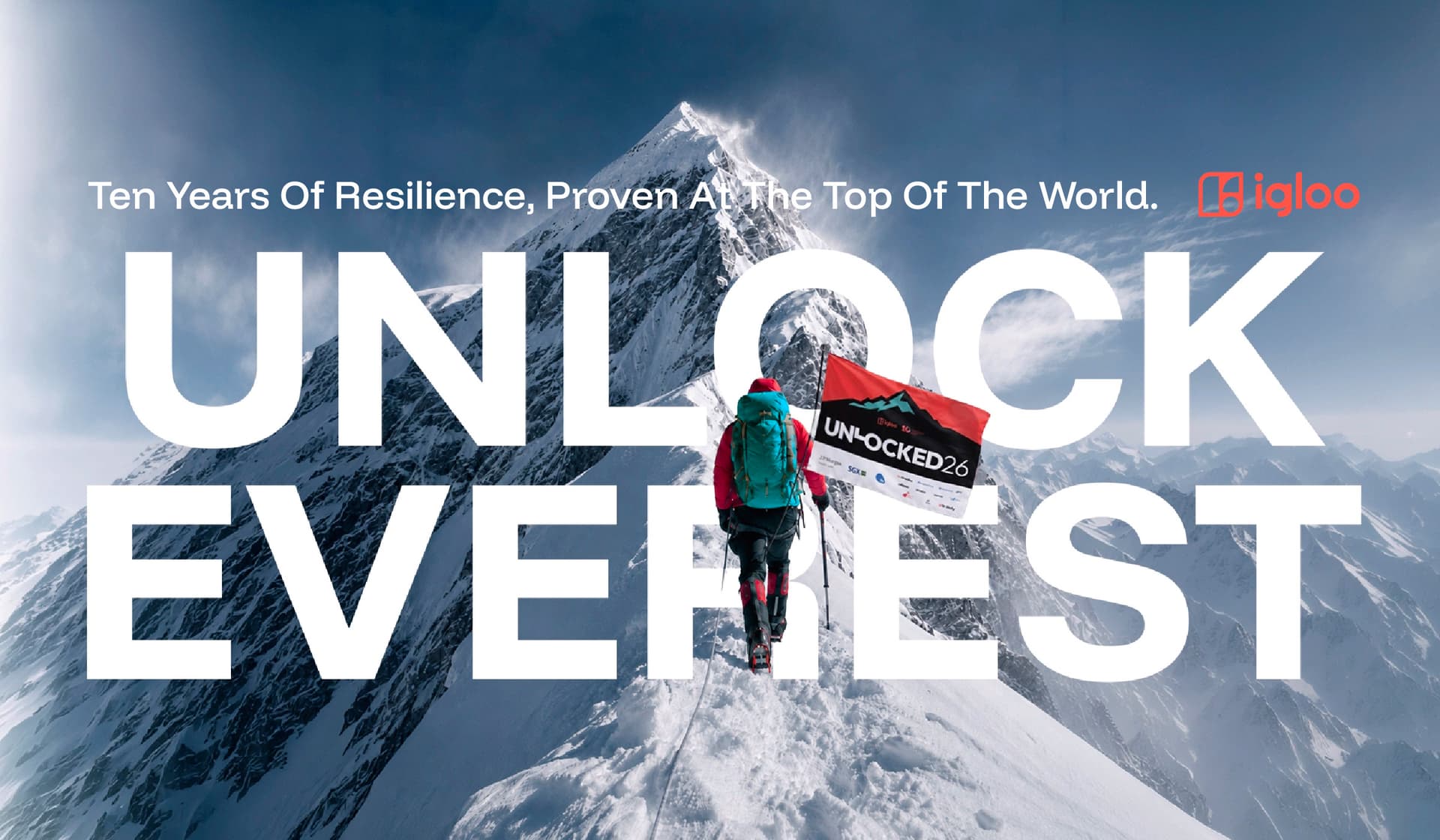
UNLOCKEVEREST: Ten Years of Resilience, Proven at the Top of the World
The wind at 8,849 metres doesn't care how good your marketing plan is. This spring, multiple members of our Everest expedition—including mountaineer and motivational speaker Jamling Tenzing Norgay, together with Pema Sherpa, Da Rinzi Sherpa and Nima Tendi Sherpa—carried igloo Lockboxes into one of the harshest environments on Earth. At the true summit of Everest, in air with roughly a third of the oxygen it has at sea level, Jamling did something almost comically mundane for a place that extreme. He pulled a glove off, keyed a PIN code into a small aluminium and polycarbonate box, and unlocked it. No signal. No WiFi. No margin for error, and no second attempt if his fingers had stopped cooperating a minute sooner.
That box was an igloohome Lockbox (SK4). That moment is the headline. It is not, however, the whole story. The real story is the ten years that came before it, and the fairly unglamorous, occasionally brutal decade of engineering that made a company confident enough to find out what its own hardware could survive.
2015, the original bet
We shipped our first smart lock in 2015 on a premise that was, at the time, a little unfashionable. Access shouldn't need a key you can lose, copy, or hand to the wrong person. It also shouldn't need a permanent WiFi connection, a monthly subscription, or a support ticket every time a router hiccups. That first lock launched with $1M in seed funding and one very good early yes, a partnership with Airbnb Paris, back when "smart lock" still read as more of a crowdfunding punchline than a category with a future.
A decade of proof, not slogans
What followed wasn't a straight line so much as a series of increasingly higher-stakes dares, each one slightly harder to walk back from than the last.
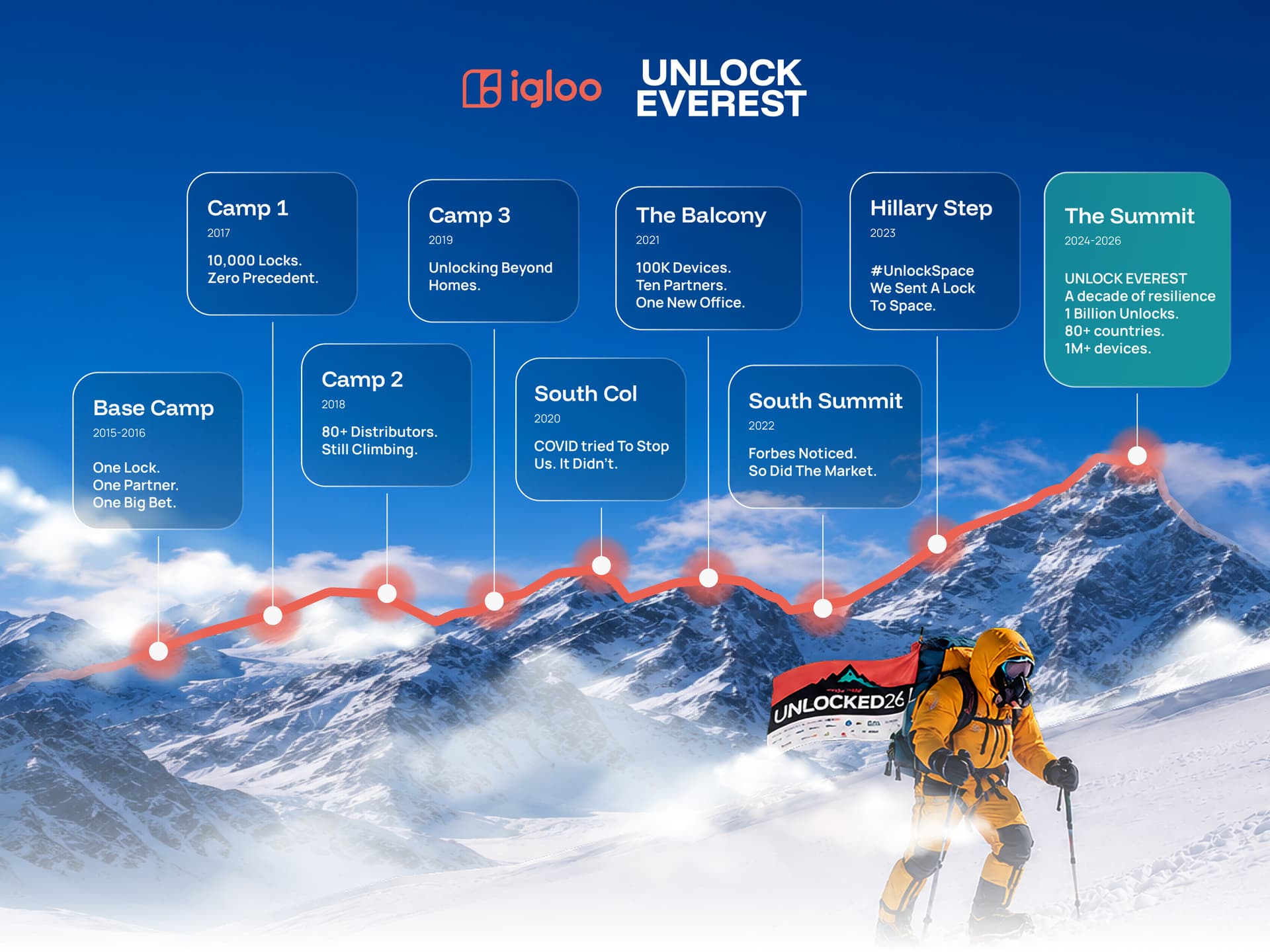 In 2016 we released the world's first Airbnb-integrated Smart Keybox, quietly retiring "I'll just leave the key under the mat" as an acceptable security plan for an entire industry. 2017 took us out of Singapore entirely, into APAC and Europe, and onto the stage of Singapore's first PropTech Hackathon. By 2018 we'd expanded into more than 80 countries, launched the Mortise Lock, and closed a $4M Series A, proof that 2015 hadn't been a fluke so much as a pattern starting to repeat.
2019 is the year we stopped thinking of ourselves as a company that made locks for homes and started asking what access could power more broadly. We launched iglooworks for enterprise clients, alongside the Smart Padlock and an upgraded Keybox 3, the same lockbox family that grew out of the original Keybox and would go on to become one of the best-selling products in the category. 2020, a genuinely brutal year for most physical-product companies, is when we opened the igloodeveloper portal and shipped Mortise 2+, choosing to build platform infrastructure at exactly the moment most competitors were retreating just to survive.
2021 brought our first U.S. operations online, alongside Push-Pull Locks and Key Fobs, into a market with famously little patience for hardware that almost works. By 2022 that bet had paid off hard enough to land us in 1,352 Lowe's stores across the U.S., alongside $12M in fresh funding and a nod from Forbes Asia.
2023, space, and the reframe nobody expected
Then, in 2023, we did something that still comes up in nearly every meeting about this campaign. We sent a Lockbox into space.
At the time, it read as a stunt, and a fairly fun one. In hindsight, it was closer to our first real resistance test outside a lab, proof the hardware could survive an environment with no atmosphere, no gravity, and zero possibility of a do-over if something failed. The same year, we launched Smart Sequence technology and opened our Singapore Experience Center, quietly continuing to build while the space stunt got all the attention.
There's a useful parallel here to something every Everest expedition runs into, a stretch called the Hillary Step, the last steep, exposed rock obstacle before the true summit and historically the single biggest bottleneck on the entire route. It's not the highest point on the mountain, but it's arguably the hardest, the place where a climb either finishes or turns back. Space was our Hillary Step. It wasn't the actual summit we were aiming for, but it was the obstacle that proved we could still take the next step after it.
Before the mountain
By 2024, we'd shipped more than 500,000 devices and were processing 8 million unlocks a year, alongside the launch of iglooAccess and OAuth iglooConnect, the kind of unglamorous infrastructure work that never makes a headline but is the actual reason a company survives a decade rather than just a launch. 2025 was spent pushing further into the U.S. and Europe and building our next generation of product lines, all in service of one long-running argument, that access should hold up anywhere, for anyone, regardless of signal, weather, or geography.
Why the Lockbox (SK4), specifically
Which brings us to the product that actually made the summit possible, and to a question worth answering properly instead of waving at with a slogan. The Lockbox isn't a metaphor for resistance. It's certified for it.
It carries an IP66 rating, meaning it's fully dust-tight and shrugs off a direct, sustained blast of water without flinching. It has an IK-07 impact rating, built to take knocks that would crack a lesser enclosure without a second thought. Its official operating range runs from -20°C to 50°C, using a body built from aluminium, steel, and polycarbonate rather than the thin plastic shells most consumer electronics get away with. Its large, tactile physical keypad is built for zero-error input, which matters far more at altitude, in gloves, with fingers that have mostly stopped cooperating, than it ever does standing in a kitchen. And its algoPIN technology generates and validates every code entirely offline, no WiFi, no signal, no dependency on a network that, at 8,849 metres, simply does not exist.
None of that was written for a campaign. It was written for a product spec sheet years before anyone at igloohome had a mountain in mind. Everest didn't inspire the resistance. It just finally gave it to a witness who happened to be standing in the right place with a camera.
The climb itself
The ascent followed the same route every Everest expedition takes, up through Base Camp, the notoriously unstable Khumbu Icefall, Camps 1 through 4, past that same Hillary Step, and onto the true summit. It's worth saying plainly that this is one of the most physically demanding things a person can choose to do, and that the real achievement belongs to Jamling Tenzing Norgay and the mountaineering team around him, not to a product spec sheet sitting in a boardroom in Singapore. Our part in this was smaller and far more specific, building the one object on that climb that wasn't allowed to be the thing that failed.
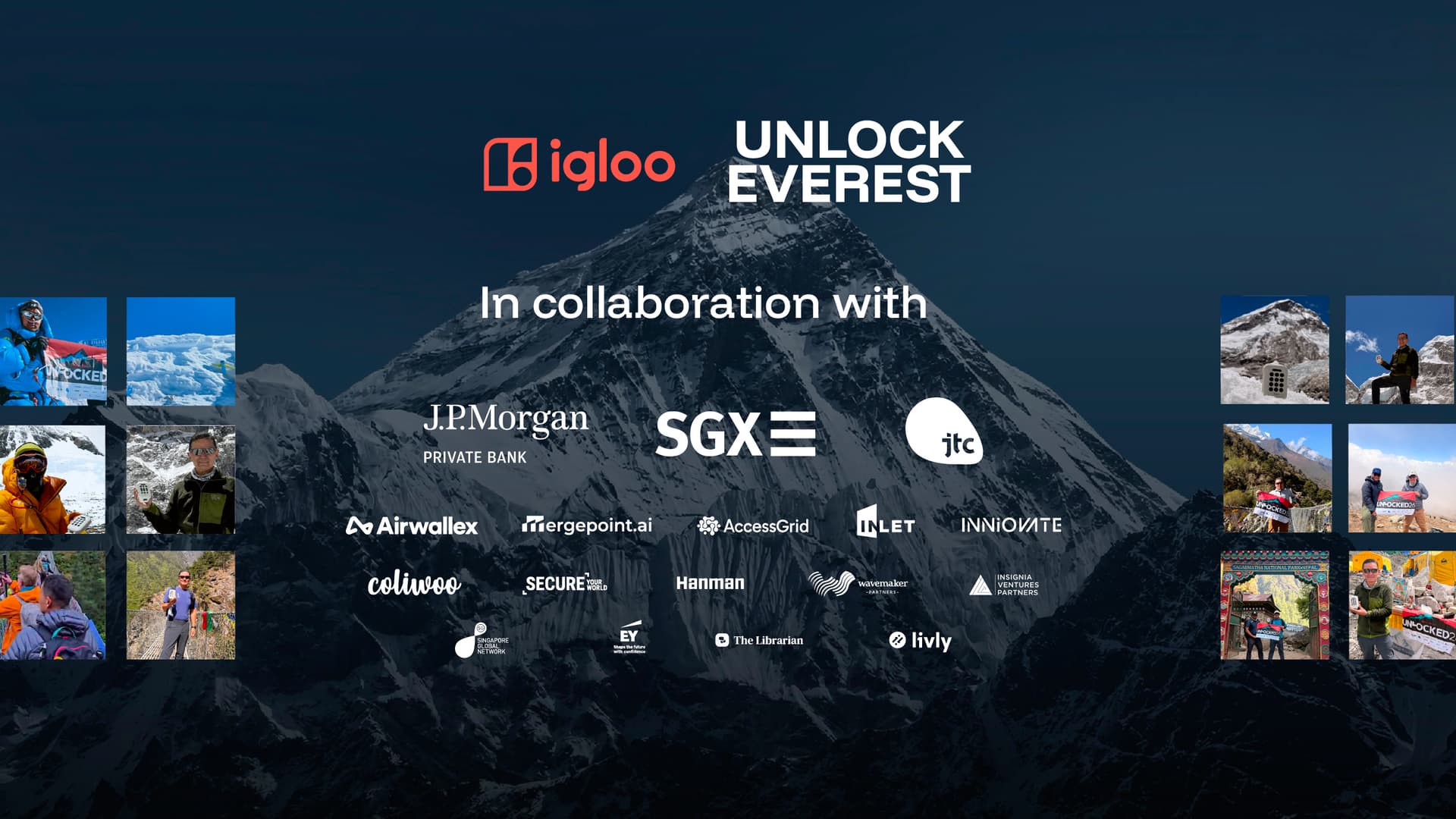
None of it would have happened without a long list of partners who backed this climb well before there was a summit photo to show for it, J.P. Morgan Private Bank, SGX, JTC, Airwallex, Mergepoint.ai, AccessGrid, Inlet, Inniovate, coliwoo, Secure Your World, Hanman, Wavemaker Partners, Insignia Ventures Partners, Singapore Global Network, The Librarian, EY, and Livly. Ten years of our growth has run alongside partners willing to bet early, and UNLOCKEVEREST is as much a thank you to them as it is a product story.
What ten years actually taught us
None of this reads as one clean value statement, and honestly, it shouldn't. But looked at together, a decade of these specific choices, not the marketing around them, does say something fairly consistent. Build for the environment that will actually test you, not the one that looks good in a product photo. Offline should mean offline, not "offline most of the time." And resistance isn't a feeling a brand gets to claim, it's a rating a product earns, then gets asked to defend somewhere far less forgiving than a showroom.
 Ten years in, just getting started
The throughline hasn't really moved since 2015. Access should hold up, not just for a curious guest jiggling a keypad in the rain, but against whatever the actual worst case turns out to be. Sometimes that's a Singapore thunderstorm. Sometimes it's zero gravity. This year, it was the summit of the tallest mountain on Earth.
Everest was cold, remote, and about as extreme as it gets. Next year, we're testing resistance somewhere that breaks the pattern entirely, and no, it won't involve snow.
UNLOCKEVEREST proved the product. The next chapter proves the range.
%20to%20Everest's%20summit.%20The%20full%20journey%2C%20every%20milestone%2C%20the%20partners%20behind%20it.)